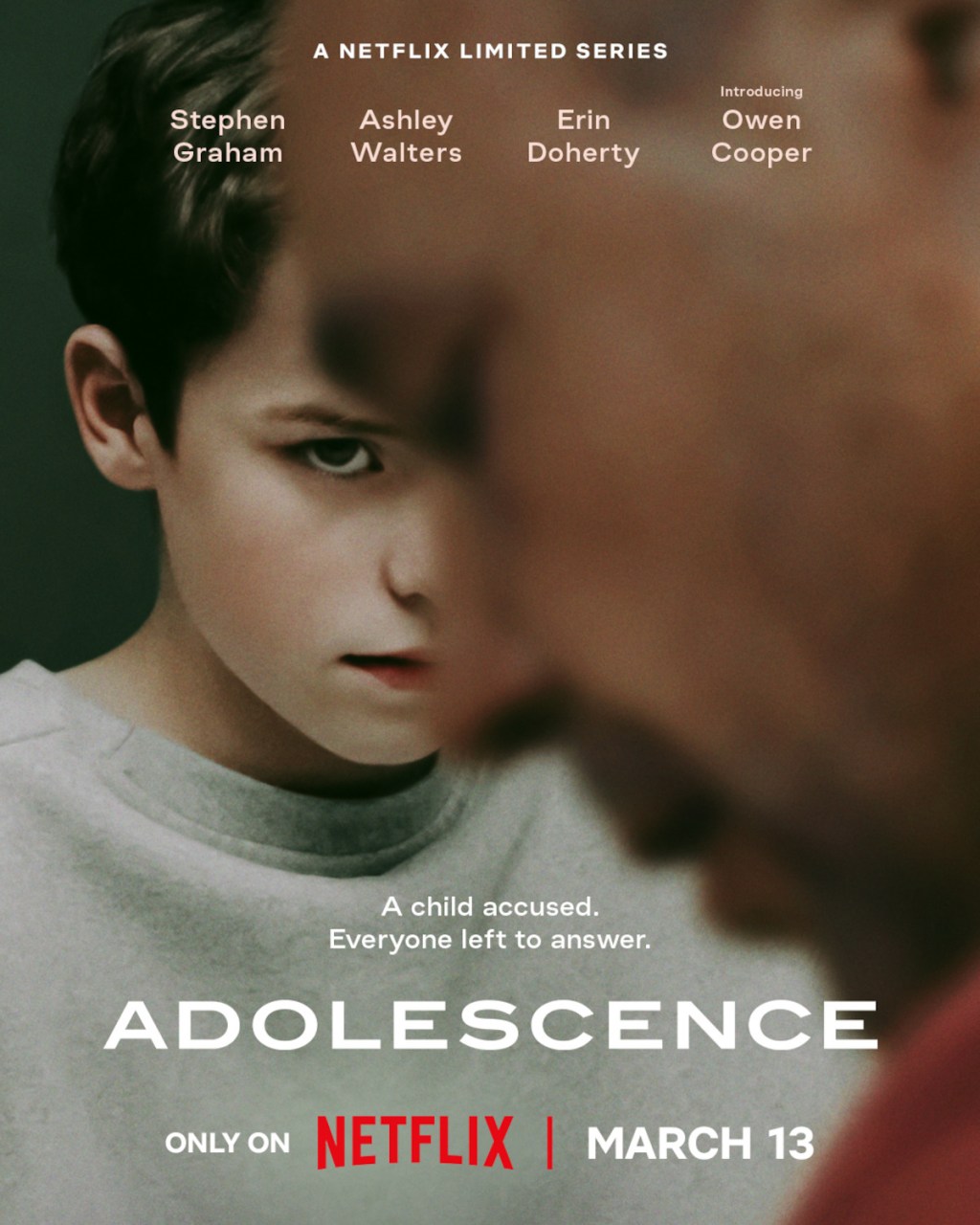
• Netflix “Adolescence” Limited Series Review
    Stephen Graham and Owen Cooper in Adolescence

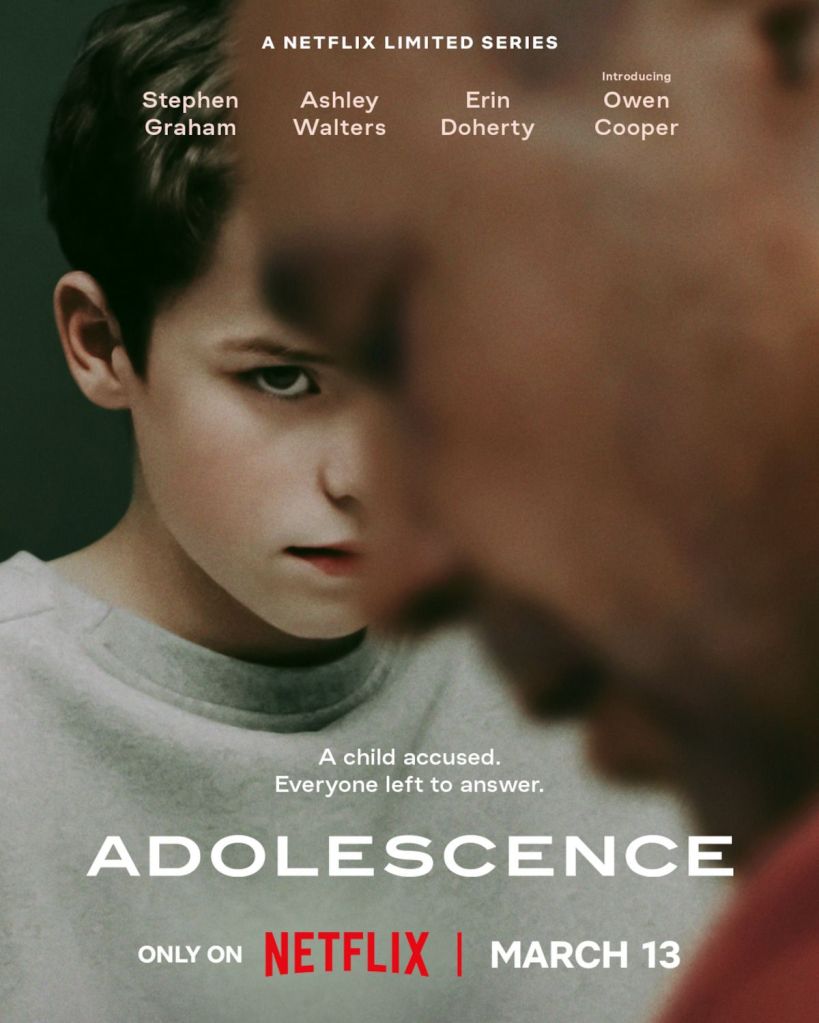
    Netflix dropped a limited series a few days ago, with no promotion or hype at all – Adolescence –  created by Jack Thorne and Stephen Graham (who also stars), and suddenly everyone seems to be praising it to the moon & back.

    But is it really praiseworthy? Or just another case of the recent trend in social media to praise everything praised by someone before, & bring down anything brought down by someone before.

    Adolescence starts off as a police procedural, with the police officers (the main guy played by Ashley Walters) taking an entire squad equipped with guns & automatic weapons to a normal-looking house in an English town to arrest – hold your breath here – a THIRTEEN year old boy Jamie,  for murder. I guess that sounds plausible enough. The thirteen year old was going to probably attack their squad or attempt running away using brute force or weaponry. And that’s just the first thing that irks you.

    The other thing that definitely irks you is the “technical brilliance” the show displays in shooting episodes in one take. Yes, that means there’s no cut in between shots. And it also means VISIBLY seeing actors wait for their cue and walk in and out of the frame, it means being aware of the camera as a viewer, it means using a technique that wasn’t necessarily called for by the story being told. One-take films or shows are not unique, but only make sense when applied to the right story – for example in 1917, when Sam Mendes used this technique seamlessly for tracking two young soldiers in WW1, servicing the story and the plot.

    One can appreciate the effort put in by the crew to shoot in one-take but the story being told in Adolescence simply doesn’t require this.

    Coming back to the script, in episode 1 the viewer isn’t told why Jamie is being arrested – for whose murder? when was it committed? what are the charges? – until last few minutes into the one hour episode. The way the father (Stephen Graham) reacts is also strange- because he isn’t told either. Assuming the police are withholding information- why does the father not demand he be told? Even in his interactions with his son, he doesn’t ask what happened? He simply asks for a promise that his didn’t commit the crime. What crime? Doesn’t the father want to know? Shouldn’t the viewer be fed with this information? This is being done simply to shock the viewer & throw them in a state of disbelief at the procedural- the steps shown in unneeded detail of how Jamie is “processed”.

    Episode 2 repeats the same trick. This time it makes us go with the police to Jamie’s school as the police go about in the most harebrained way to ascertain the motive and find the knife that was used. Why would the police not use discretion to question students? Why would the school allow them to enter class after class and create commotion? This is again done only to elicit a reaction from the viewer and not tell the story. And there are major plot holes – what happened to the girl who reacts violently in this episode to police questioning? why did the teacher react awkwardly? why does the school bell go off when the police are talking to a full class?

    But in terms of script issues and storytelling flaws – Episode 3 takes the cake. This is the episode being praised the most. The entire episode focuses on a “session” between a psychologist (played one-note by Erin Doherty) and Jamie. She repeatedly questions Jamie in a way that seems to be inappropriate and unreasonable simply to service the intent of the show. And the conversation provides no new light – because it is the same conversation between the police officer and his son (who is two years senior to Jamie in the same school) from Episode 2. The entire thing hinges on a few emojis & posts on Instagram and these social media exchanges between Jamie and the victim ( a girl from his school called Katie – that’s all we know of her even by the end of Episode 3 and Episode 2 makes sure to focus on a dialogue from the police officer’s female partner where she says “you know what’s sad – even after all this we’ll only remember Jamie , no one will remember Katie “. Well, well. Talk about not walking the talk.

    The series tries to portray Jamie as a boy who has serious issues – it throws around words like incel, masculinity, and many such terms – without actually telling us if he truly is like that. And if he is what caused him to be so? For adolescents who come with complexities that may lead to violence or crimes watch something like American History X or even The Sinner that uses a complex narrative to delve into a complex psyche.

    Here we are supposed to get affected by Jamie’s behavior only because the psychologist who’s there to assess him (a lady again) is showing us her reactions of fear, relief etc on screen. Why is she getting affected by this perfectly okay teenager when she’s a professional and she’s the one badgering him with nasty questions, many of them sexual in nature? The episode doesn’t delve into Jamie’s psyche. How does an adolescent’s malleable mind work? What causes bad influence or violent decisions? It simply uses trending terminology to influence us into thinking what Jamie is and that too filtered through the lens of the lady psychologist.

    The acting is being praised and Owen Cooper, a first time child actor definitely needs to be praised. Stephen Graham is decent. We’ve seen him in better roles including The Irishman, where he absolutely shone in front of greats like Al Pacino and Robert De Niro. Ashley Walters is okay. Erin Doherty seems to be channelising a victim rather than a trained professional in her acting.

    Overall, Adolescence comes off as a show toxic in its portrayal of a thirteen year old boy to service the showrunners’ desire to pander to current trends, and its unnecessary gimmick of one-take episodes has definitely payed off in earning praise from an audience deprived of quality content to such an extent that a show such as this comes off as “brilliant content”.
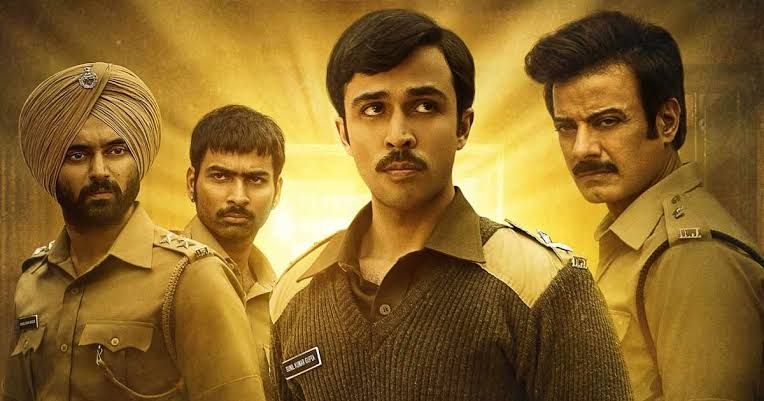
  • Black Warrant : Hindi Series on Netflix

    FCC take: A superb ensemble cast anchored by the assured Zahaan Kapoor and the edgy Rahul Bhat, elevates the already good material under Motwane’s dual eye for aesthetics & realism, making Black Warrant one of the best offbeat shows in recent times

    Jubilee was a runaway success for Netflix last year, and the streaming platform seems to have scored again by letting Vikramaditya Motwane anchor another fresh series, Black Warrant.

    Based on a screenplay adapted from a book based on real events, Motwane & co-showrunner Satyanshu Singh, the series casts newcomer Zahaan Kapoor (the great Shashi Kapoor’s grandson) in the role of Tihar jail jailer Sunil Gupta, & other fresh faces Paramvir Cheema & Anurag Thakur as his coworkers and buddies in Tihar, with Rahul Bhat (Ugly, Kennedy) playing the Dy Superintendent who calls the shots.

    But does he really? As the story deepens we meet the other key players in the jail – the gangs who truly run the show, & the jail’s mor (peacock) (as the show repeatedly calls him) , an enigmatic, slithering, dangerous Charles Sobhraj (played superbly by Sidhant Gupta).

    The series is consistently engaging, playing out as a series of experiences from the jailers’ point of view. This makes the series episodic, each of the seven episodes playing out as a new problem for the team to face & get out of.

    The technical aspects are stellar – cinematography, sound design, editing – all supporting the directors’ vision.

    The high points of the series are the first two episodes  – the first one sets the tone & lays out all the players, the second one is about the titular black warrant, the death sentence & hanging of two of the jail’s infamous inmates, a harrowing, intense watch – & this also means the series peaks early, which is both a good & a bad thing. The other thing that stands out as a miss is the characterisation of the women, except Rajashri Deshpande who rises above her thinly written reporter role in Episode 2, the rest of them are written without detail or backstory & hence don’t become memorable.

    The real highlight of the series is the camaraderie that is truly brought to life by Kapoor, Cheema & Thakur – their changing dynamics & performances carry the show all through to the finale.

    OverallBlack Warrant is a solid series from creator & director Vikramaditya Motwane, & its greatest contribution could be the addition of some very fine actors to the Hindi cinema / OTT scene. Watch the whole series on Netflix.

  • Filmcontentcentral™’s entire team would like to thank you all for your overwhelming response to LensQuest.

    We received beautiful, brilliant photographs capturing nature, wildlife, cityscapes, nighttime views, portraits, life moments, etc.

    All photographs had character, and we were looking for ones with the most.

    So, after careful curation, and considering not just the photograph, but also the story behind it, it is time to announce the winners.

    Special Mention

    Maanda Mannan Kaaviyam ( Lost King’s Tale) by Parameshwari

    Lost King’s Tale by Parameshwari 

    From Tamil Nadu, the place of culture, heritage and many historic tales, this photograph expresses the story of the king who lost all his glory and ended up with only faith and hope in himself

    Third Prize

    Grin & Grit in Motion by Shehasis Karmarkar

    Grin & Grit in Motion by Shehasis Karmarkar

    This is a picture taken in a place where these boys have to earn money by giving people horse back rides and they have started it at such an early age. One of them is enjoying it at its fullest while the other is grumpy telling that not everybody is the same. These are the two ways we look at life

    Second Prize

    City Reflections: Vibrant Pulse of Kolkata by Soumavo Kumar

    City Reflections by Soumavo Kumar

    In the heart of Kolkata, the vibrant city of joy, a rainy day becomes a canvas of reflections and emotions. The wet street glistens like a mirror, capturing the life above it—a visual symphony of chaos and connection.

    In the frame, a classic yellow taxi cruises by, embodying the city’s tireless spirit and timeless charm. In the foreground, a couple stands under a shared umbrella, their bright attire glowing against the muted gray of the rain-drenched street. The harmony of their moment contrasts with the fast-paced life around them, symbolizing intimacy amidst urban hustle

    First Prize

    Chikhalgutta by Suresh Khaire

    Chikhalgutta by Suresh Khaire

    Chikhalgutta is a unique celebration observed in Kolhapur, Maharashtra. This is more specifically a Bail Race in the villages of Maharashtra that takes place between bullocks or buffalo [Bails]. The event features a thrilling Bail race which is the main attraction.

    This photograph symbolises the event’s scenic beauty, rural charm and cultural significance. A true display of skill, strength and teamwork between the bail/buffalo and its owner.

    A big congratulations to all the winners!

    Our team has sent out the Amazon Vouchers to your registered email IDs.

    Thank you again and hope to see you all and many more new participants in LensQuest 2.

  • 2024 Best Films!!

    Maharaja, Meiyazhagan, Kalki 2898AD, Chamkila, Kishkindha Kaandam, and many more!

    So many movies deserve to be on this list, but at Filmcontentcentral, we handpick five movies for you that you simply shouldn’t miss!

    (In no particular order)

    Chamkila (Imtiaz Ali)

    Hindi cinema had many releases this year, but only a handful were good.

    Vidya Balan’s Do aur Do Pyaar, also starring an excellent Pratik Gandhi, was a great rom-com, but one that not many saw. The spy thriller, Berlin, starring Ishwak Singh, Aparshakti Khurana & Rahul Bose, was another standout. But the real standout of the year was Imtiaz Ali’s big comeback, Chamkila, based on the life and songs of Punjabi singer Amar Singh Chamkila. Starring an authentic and natural Diljit Dosanjh, with a credible Parineeta Chopra lending support, the movie is mainly great due to Imtiaz Ali’s fearless and innovative direction, blending sync-sound songs sung by the actors with archival footage and a non-linear screenplay.

    Meiyazhagan (C Prem Kumar)

    What Prem Kumar manages to achieve with Meiyazhagan is something unique. Just like he did with his earlier hit and fan favorite ‘96.

    The movie, starring a spectacular Arvind Swamy and Karthi, is a bittersweet take on a simple relationship, but the way the screenplay weaves incidents & small moments into the narrative, makes for a special ride.

    Watch our full review of Meiyazhagan here

    There were other movies in Tamil that were good this year, including the December release Viduthalai Part 2 (Vetrimaaran) and Thangalaan (Pa Ranjith). But two stood out for us, Meiyazhagan and…

    Maharaja (Nilanthan Saminathan)

    Maharaja was a marvel in the thriller genre. A big hit critically and commercially and in all languages, the movie excited viewers with its multi-timeline and non-linear narrative, the director confident of his story and actors (a superb Vijay Sethupathi) to pull off the complexity of the screenplay.

    And it paid huge dividends. Maharaja is a modern classic as far as thrillers go, joining the likes of Sujoy Ghosh’s Kahani.

    Kalki 2898AD (Nag Ashwin)

    Despite the many flaws, including a first half that doesn’t work, director Nag Ashwin has to be applauded for the scope of his vision. And for reimagining the complex character of Mahabharat’s Ashwatthama, and setting the character is a futuristic setting. The biggest credit for this of course goes to the megastar that is Amitabh Bachchan. And the actor that he is.

    Also, the very brief scenes of the battle of Kurukshetra that bookended the film, were magnificently done.

    Kishkindha Kaandam (Dinjith Ayyathan)

    Malayalam cinema has been at a high since the last few years. Bold stories, brave directors, actors willing to take risks, excellent technicians.

    There were many movies that impressed, including Aavesham where Fahadh Faasil was a hoot and Malaikottai Vaaliban, the superlative collaboration (it is a movie we believe will gain a cult status over time) between Mohanlal and Lijo Jose Pelissery.

    But Kishkindha Kaandam, the year end release starring Asif Ali and Vijayaraghavan stood out as a solid film, except the very last minutes of twists that undoes some of the good work done earlier. But it is again an excellent, offbeat script, executed with a lot of finesse by the director.

  • Storytelling has existed since the dawn of humanity, with books and movies closely intertwined throughout history. A great book sparks imagination, stirs emotions, and weaves complex plots. When adapted into a movie, it comes alive visually, reaching a broader audience. The Netflix adaption of Gabriel García Márquez’s “One Hundred Years of Solitude” highlights the ongoing, intricate relationship between books and cinema.

    From book to film

    The Art of Adaptation:

    The Process of Turning Words into Visuals

    Adapting a book into a movie is a challenging task, requiring the distillation of complex stories into a two-hour film. When done well, it can become a masterpiece, like Peter Jackson’s The Lord of the Rings trilogy, which brought Tolkien’s world to life. Similarly, To Kill a Mockingbird (1962) effectively captured Harper Lee’s exploration of racial inequality, with Gregory Peck’s portrayal of Atticus Finch becoming iconic.

    Gregory Peck in his iconic role

    Unfortunately, not all adaptations succeed; “Eragon” (2006) disappointed fans, showing that a great book doesn’t always lead to a great movie.

    Indian Books and Their Cinematic Insights:

    What is a land full of culture and cinema without its fair share of adaptations? India has a fair share of adaptations alongside South Asian countries. If we take a look, Satyajit Ray’s Apu Trilogy is one such work that bears the stamp of Ray’s deep-seated belief in the fundamental possibilities of adaptation. This helped Shahr’s movies in procreating the rustic charm of Bengal the world over.

    Vikram Seth’s “A Suitable Boy” was recently adapted into a TV series, and Arundhati Roy’s
    “The God of Small Things” is also being considered for adaptation. Indian cinema has long adapted literature, from Sarat Chandra Chattopadhyay’s “Devdas” to Chetan Bhagat’s “3 Idiots” and “Five Point Someone”.

    Across the Globe

    Marlon Brando is The Godfather

    Globally, literature and cinema have birthed some unforgettable classics. Here’s a list of some of the best book-to-movie adaptations:

    The Godfather (1972) – Based on Mario Puzo’s novel, Francis Ford Coppola’s film remains a cinematic masterpiece.

    Pride and Prejudice (2005) – Joe Wright’s lush adaptation of Jane Austen’s beloved novel brought Elizabeth Bennet and Mr. Darcy’s romance to a new generation.

    Life of Pi (2012) – Ang Lee turned Yann Martel’s philosophical novel into a visually stunning masterpiece.

    The Great Gatsby (2013) – Baz Luhrmann’s interpretation of F. Scott Fitzgerald’s classic divided critics but dazzled audiences with its opulence.

    Slumdog Millionaire (2008) – Adapted from Vikas Swarup’s Q & A, this film captured the world’s imagination, winning multiple Oscars.

    Regional Cinema: The Hidden Gems

    Kalki’s magnum opus Ponniyin Selvan

    While Hollywood and Bollywood adaptations are widely celebrated, regional cinema has its treasure trove of literary adaptations. Here are a few noteworthy mentions:

    Marathi: Katyar Kaljat Ghusali (2015) is a musical masterpiece adapted from a Marathi play, blending storytelling with Indian classical music.

    Malayalam: Oru Vadakkan Veeragatha (1989) reimagines a folk tale with stunning cinematic depth.

    Kannada: Gandhada Gudi (1973), inspired by literary works, showcases Karnataka’s natural beauty and cultural heritage.

    Tamil: Adaptations like Ponniyin Selvan and Paruthiveeran (2007) explore erstwhile royalty, rural life and human emotions, offering culturally rich and authentic stories.

    What Makes A Good Adaptation?

    Great adaptations go beyond translating words into film; they capture the essence of the original work and adapt it to the cinematic medium. Successful adaptations, like The Shining, take bold steps that enhance the story, while others, like Percy Jackson, fail when key elements are altered poorly.

    Human emotions, such as grief, triumph, or longing, are universal, and it’s these feelings that connect audiences to the story. Films like Harry Potter and Atonement succeed because they stay true to the emotional core of the books, resonating deeply with viewers.

    Why We Love Seeing Books on the Screen

    The excitement of seeing beloved characters come to life is one reason why anticipation for Netflix’s “One Hundred Years of Solitude” is growing. Gabriel García Márquez’s magical realism, set against the Buendía family’s saga, offers endless possibilities for visually stunning and emotionally charged scenes.

    Beyond the visuals, film adaptations provide fresh perspectives, encouraging filmmakers to explore genres, update themes, and offer new interpretations. For readers, this means experiencing the same story from a completely different angle.

    While the saying “books are the movies in our mind” holds some truth, each medium has its own strengths. Ultimately, both the reader and viewer must immerse themselves fully—whether by reading the entire book or watching the full film.

    Conclusion: A Love Affair That Lasts Forever

    Read a book Or Watch a Movie?

    Well, both books and films are a way of storytelling. The latter provides a basis for a wandering mind while the former offers sight. Together, they form an everlasting tie that is not static but is continuously evolving and pleasing as well.

    As we are now enjoying Netflix’s And Western Media’s One Hundred Years of Solitude, let us take the moment to enjoy this fusion of art- the book and the movie. The essence lies in the fact that a good story always manages to present itself, whether the medium is pen on paper, or a camera for the silver screen.

  • Asif Ali in the poster

    FCC take: Now, this is one great script! If only the endgame was as satisfying.

    Right from the outset, you can sense Kishkindha Kaandam, starring Asif Ali and Aparna Balamurali in the leads, is going to be a different, thrilling movie, just by how it opens and sets up a story and a plot that doesn’t let the audience fully in, playing its cards close to its chest.

    Is the movie about a forgetful, cranky old man (played wonderfully by veteran Vijayaraghavan) or is it about mischievous monkeys who steal things, is it a crime thriller about a missing gun or the murder mystery of a missing  boy? The script by Bahul Ramesh (also the cinematographer) doesn’t tell you.

    The direction (Dinjith Ayyathan) is taut and moody (helped by a mystical background score) right until the last fifteen minutes, where the movie’s final twist doesn’t land in line with the things that came before.

    The acting is stellar from Asif Ali & Vijayaraghavan, Aparna Balamurali is decent in a role that asks for a bit more of an inspired interpretation.

    Overall, Kishkindha Kaandam is another unique tale from the Malayalam film industry, the story of a missing revolver that keeps morphing into something more. Watch it on Disney+ Hotstar.

  • Event Calendar

    Visual Language in Film marketing

    14 January ’25 – 21 January’25

    Venue : Online workshop

    Speaker: Karthika AK (certified ux expert)

    Prices: Rs 1100

    For details and enrolling , DM us on Instagram at @ the_contentcentral

  • Our first ContentARC™ original, “A Stranger’s Hand” is out now on our platforms.

    To watch :

    A Stranger’s Hand

    About ContentArc™:

    ContentArc™ is our registered trademark for short format film. Trademark application number: 6704603 Class 35

  • Our Quick Take

    Ye Kaali Kaali Aankhen, on Netflix, season 2, starring Tahir Raj Bhasin and Payal Singh is a thrill ride from start to finish, albeit with a story that feels stretched. It could have been tighter and edgier be on par with its season 1

    Watch this space for a detailed review

  • Filmcontentcentral™’s entire team would like to thank you all for your overwhelming response to ShortFilmQuest and sharing your short films with us.

    Beautiful films, in all genres. Drama, Crime, Romance, Thriller, Social Cause, Horror, SciFi.

    And now after careful curation, it is time to announce the winners.

    Special Mention

    CONSOLE by Nikhil Jose

    A short one minute film that sends a simple but effective message and is executed with panache

    Third Prize

    ANAIYAADHA VILAKKU (Inextiguishable Flame) by Rameez

    This short film blends horror with drama & a social cause, and the clear, crisp screenplay makes it a winner in our eyes

    Second Prize

    AEVAAN THE AI by Bala Sanish

    A wonderfully imaginative, technically brilliant (special mention for the special effects, digital background tendering), this sci-fi film left us wanting for more. A winner all the way for its technical brilliance.

    First Prize

    TWILIGHT MURDER by Sangeeta Shekhar

    This daring, scintillating short film with a thrilling twist is brilliantly written and acted, telling a complete story in a limited format. Definitely a winner!

    A big congratulations to all the winners!

    Our team has sent out the Amazon Vouchers to your registered email IDs.

    Thank you again and hope to see you all and many more new participants in ShortFilmQuest 2.